Il y a des clips esport qui tournent des millions de fois. Un ace en pistolet, une voix de caster qui part dans les aigus, une foule qui se lève d'un coup. Et il y a les mêmes actions, filmées pareil, qui font 400 vues et crèvent dans l'oubli.
La différence, ce n'est presque jamais le skill du joueur. C'est comment le moment est clippé. Le cadrage, le hook, le timing, l'émotion que tu gardes ou que tu jettes au montage.
Cet article te donne la méthode pour clipper l'esport proprement. Ce qui rend un highlight viral, quel type de moment marche par jeu, et le workflow exact pour sortir des clips verticaux qui percent. Avec un rappel important sur les droits, parce que dans l'esport c'est vite un piège.
Ce qui rend un highlight esport réellement viral
Un bon highlight compétitif se lit en deux secondes. Quelqu'un scrolle, il te donne à peine le temps d'un battement de cil. Si en deux secondes il ne comprend pas qu'il se passe un truc dingue, il est déjà parti.
Cinq types de moments marchent presque à tous les coups. Le clutch 1vX d'abord, un joueur seul contre plusieurs que tout le monde donne mort et qui retourne la situation : tension maximale, résolution nette. L'ace ou le multi-kill ensuite, un mec qui nettoie l'équipe adverse, lisible même si tu ne connais pas le jeu. L'upset, le petit qui bat le favori, parce que tout le monde adore le sous-estimé. La mécanique de folie, le flick impossible ou le timing frame-perfect qui déclenche le "attends, comment il a fait ça". Et le comeback, mené 0-2 puis remonté 3-2, l'arc narratif complet en trente secondes.
Mais l'action seule ne suffit pas. Ce qui fait exploser un clip esport, c'est l'émotion autour. La voix du caster qui craque. La foule qui hurle dans l'arène. Ta propre réaction en watch-party quand tu te lèves de ta chaise. C'est ça qui donne le frisson, même à quelqu'un qui n'a jamais lancé le jeu.
Retiens ce réflexe : un highlight sans réaction, c'est une info. Un highlight avec réaction, c'est une émotion. Et l'émotion, ça se partage.
Quel moment clippe le mieux, jeu par jeu
Chaque jeu a sa signature virale. Tu ne clippes pas Valorant comme tu clippes Rocket League. Voilà le type de moment qui rentre le mieux sur chaque titre.
Valorant : le clutch 1v3, 1v4, 1v5 et l'ace. C'est le pain quotidien du clip Valorant. Un Reyna ou un Jett qui claque un ace en round de pistolet, ça part tout seul. Les défuses last-second et les gros flicks Operator marchent aussi.
League of Legends : le teamfight bien lu et l'outplay 1v2. Un pentakill, un flash-engage qui retourne un combat, un Zed qui outplay son adversaire de lane. Le problème du LoL, c'est la lisibilité, donc tu privilégies les actions courtes et claires plutôt que les teamfights confus à dix personnes.
CS2 : le 1vX à l'AWP et les clutchs de retake. Le CS reste lisible et brutal. Un joueur seul en retake avec la bombe qui tick, quatre ennemis, et il les enchaîne. La tension du timer fait la moitié du travail.
 Counter-Strike 2 - key art officielle
Source : Valve
Counter-Strike 2 - key art officielle
Source : Valve
Fortnite : le build-fight et le clutch de fin de partie. La mécanique de construction impressionne les gens qui ne jouent pas. Un edit-course propre suivi d'un kill, ça fait "wow" même hors communauté.
Apex Legends : le 1v3 et les mouvements techniques. Un wraith qui clean une squad entière, un mouvement de mobilité (tap-strafe, wall-bounce) suivi d'un kill. L'énergie chaotique d'Apex se prête bien au format court.
 Apex Legends - key art officielle
Source : Electronic Arts / Respawn
Apex Legends - key art officielle
Source : Electronic Arts / Respawn
Rocket League : la ceremony aerienne et le save impossible. Rocket League est visuellement propre et compréhensible par n'importe qui. Un ceiling shot, un double touch aérien, un save de la dernière chance sur la ligne. Pas besoin de connaître le jeu.
 Rocket League - key art officielle
Source : Psyonix / Epic Games
Rocket League - key art officielle
Source : Psyonix / Epic Games
Fighting games : le comeback clutch et le read parfait. Un joueur à un pixel de vie qui remonte tout, un parry ou un punish parfaitement lu. La foule des tournois FGC est la meilleure du monde pour amplifier un moment, profite de ce son.
Le point commun : dans chaque jeu, tu cherches le moment le plus immédiatement lisible, pas forcément le plus techniquement impressionnant pour un pro. Un clutch simple mais clair bat un outplay génial mais illisible.
Le hook : les 2 secondes qui décident tout
Sur TikTok, Shorts ou Reels, tout se joue avant la 3e seconde. Le viewer décide de rester ou de scroller pendant que le clip charge encore.
Pour l'esport, tu as deux écoles de hook qui marchent :
Montrer le résultat d'abord. Tu ouvres sur le pic d'émotion (la foule debout, ton cri, le "ACE" à l'écran) puis tu reviens dérouler comment on en est arrivé là. Le viewer reste pour comprendre.
Poser la tension d'abord. Un texte overlay simple genre "1 vs 4, il reste 8 secondes" et le viewer reste pour voir si ça passe. Le suspense fait le boulot.
Ce que tu évites : ouvrir sur 5 secondes de contexte mou où il ne se passe rien. Personne n'attend. Coupe le gras du début, entre directement dans le vif.
Tu veux ces clips dans ta vie ?
StreamClipping transforme tes lives en clips verticaux prêts à poster, sous-titres animés inclus. Plan gratuit à vie, 15 min de vidéo par mois, sans carte bancaire.
Le workflow complet pour sortir le clip
Une fois que t'as ton moment, voilà les étapes dans l'ordre. C'est là que 90% des gens perdent leurs bangers, par flemme ou par manque de méthode.
1. Récupérer le passage. Depuis ta VOD Twitch, YouTube ou Kick de watch-party, ou depuis ton propre enregistrement de partie. Tu notes à peu près le timecode pendant que tu joues ou que tu regardes, ça t'évite de scrubber des heures.
2. Cadrer en vertical 9:16. L'esport est horizontal, ton clip doit être vertical (1080x1920). Tu gardes l'action au centre et tu poses ta facecam ou ta réaction en haut. Pour les jeux très larges comme LoL ou Rocket League, un léger zoom sur la zone d'action vaut mieux qu'un crop bête qui coupe la moitié utile.
3. Sous-titres animés. Non négociable en 2026. Beaucoup regardent sans le son au début. Les sous-titres mot par mot gardent l'attention et rendent ta réaction lisible même en silencieux.
4. Timing serré. 15 à 40 secondes. Tu coupes tout ce qui n'est pas essentiel. Le montage d'un highlight, c'est de la soustraction, pas de l'ajout.
5. Publier en batch. Un seul clip ne suffit pas. La régularité bat le coup de chance. Poste plusieurs clips par jour sur TikTok, Shorts et Reels plutôt qu'un banger isolé par semaine. Une seule watch-party peut nourrir une semaine entière, comme détaillé dans le guide 1 stream = 30 clips.
Sur ce workflow, l'outil que j'utilise, c'est StreamClipping. Tu lui donnes le lien de ta VOD, sa détection multi-modale (pics audio, frames vision, punchlines du transcript) repère les moments forts, et le mode Magic génère 5 à 10 clips verticaux 9:16 avec sous-titres animés, hooks et effets depuis une seule VOD. L'export est en 9:16 natif 1080x1920, directement depuis Twitch, YouTube ou Kick. Le plan gratuit te donne 15 minutes de vidéo par mois à vie sans carte, et l'inscription débloque un essai Elite de 7 jours, avec 1 h de vidéo par jour, pour tester à fond.
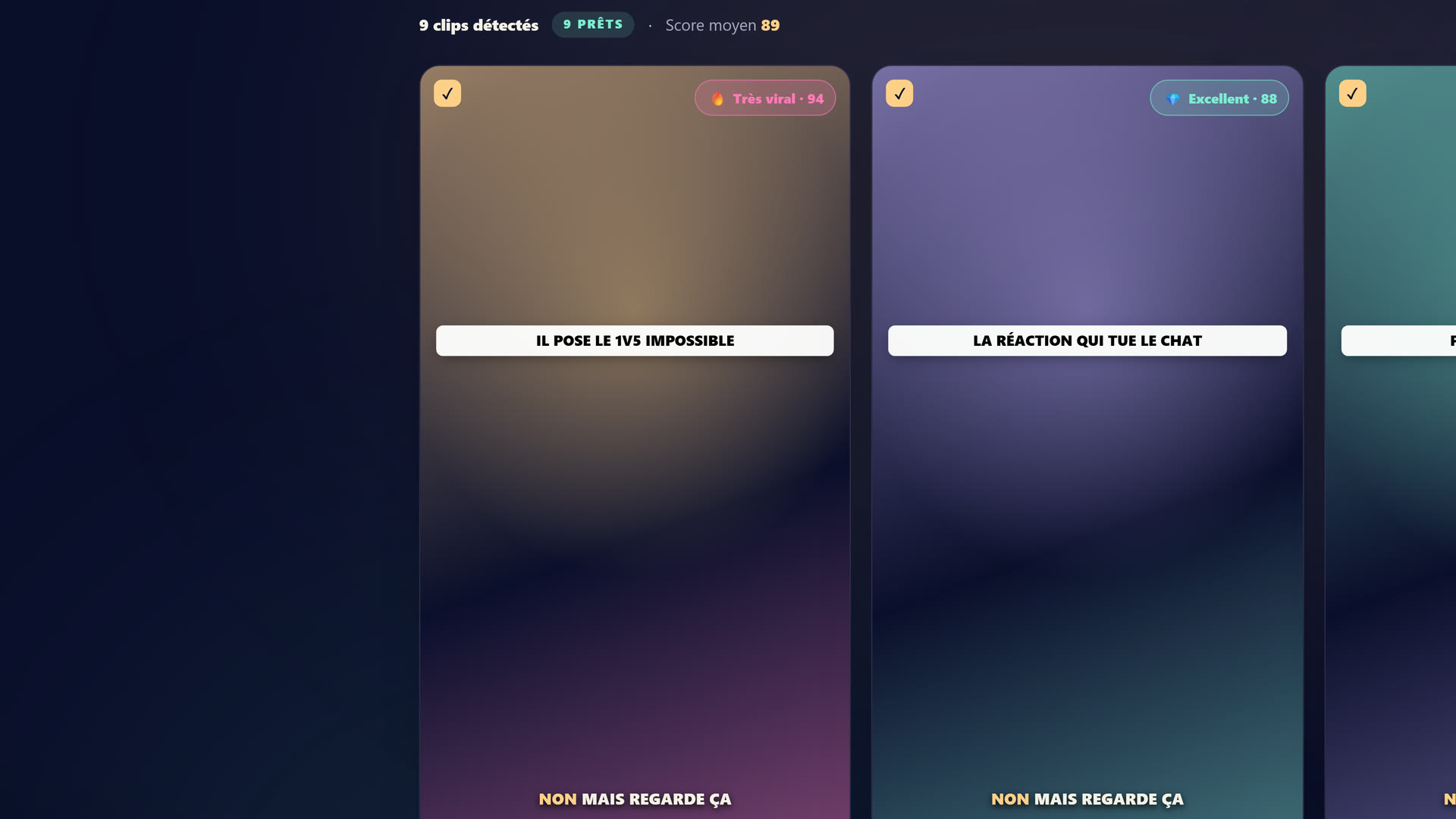 Le studio StreamClipping : tu colles le lien de ta VOD Twitch, YouTube ou Kick, l'IA repère les moments forts et sort les clips verticaux 9:16.
Si tu veux enchaîner derrière avec la publication automatique, l'AutoPilot programme et poste tes clips sur TikTok, YouTube Shorts et Instagram Reels sans que tu touches à rien.
La partie qui fâche : les droits sur le contenu esport
Là il faut être honnête avec toi, parce que dans l'esport c'est vite un piège à strikes.
La diffusion officielle d'un tournoi appartient à ses ayants droit. Riot, ESL, Blast, les orgs, les casters. Le gameplay lui-même appartient à l'éditeur du jeu. Donc reposter le flux officiel brut d'une finale de Champions, même clippé joliment, ce n'est pas ton contenu. Tu risques un blocage, un strike, une démonétisation, voire pire selon la plateforme et l'ayant droit.
Le plus sûr, et de loin, c'est de clipper ce que tu produis toi-même :
- Tes watch-parties avec TA réaction en cam. C'est ta réaction qui est le contenu original, pas le flux derrière. Beaucoup de créateurs vivent de ça, mais reste dans les règles de co-streaming autorisées par l'organisateur (Riot et d'autres cadrent le co-streaming, vérifie leur programme).
- Tes propres runs ranked ou tes scrims. Là c'est ton gameplay, ta voix, aucune ambiguïté.
- Tes analyses et breakdowns où tu commentes par-dessus des extraits courts avec une vraie valeur ajoutée.
La règle simple que je m'applique : avant de reposter du contenu officiel, je vérifie les conditions de l'éditeur ET de l'organisateur. Et dans le doute, je clippe ma réaction plutôt que le flux. C'est moins risqué et souvent plus viral, parce que les gens viennent pour l'émotion, pas juste pour l'action qu'ils peuvent voir partout ailleurs.
Chaque nouvel article dans ta boîte, zéro bullshit.
Un mail quand un article sort, jamais plus d'un tous les deux jours. Les techniques virales, les outils IA qui valent le coup, les formats TikTok qui marchent. Pas de spam, pas de pitch agressif.
Monétiser tes highlights au-delà de ta chaîne
Une fois que tu sais sortir des clips esport propres, tu peux les rentabiliser autrement qu'en vues sur ta propre chaîne. Des créateurs et des orgs lancent des campagnes de clipping payées aux vues, où tu es rémunéré au CPM pour les clips que tu publies pour eux.
Pour trouver ces campagnes sans fouiller dix Discord, StreamClipping propose /discover, un annuaire qui agrège les campagnes payées (Vyro, Whop et autres) avec le CPM et la plateforme affichés d'avance. Tu vois combien tu peux toucher avant de te lancer. Si tu veux creuser le sujet du clipping payé et des jeux qui rapportent, jette un œil aux guides sur les meilleurs jeux à clipper en 2026 et sur le logiciel de clipping 2026.
Le calendrier esport : surfe sur les gros événements
Les highlights esport ont un énorme avantage sur le contenu evergreen : les gros événements créent des pics de recherche et d'attention massifs. Champions Valorant, Worlds LoL, les Majors CS2, l'EWC. Pendant ces fenêtres, tout le monde cherche des clips, l'algorithme pousse le thème, et un clip bien fait profite de la vague.
Ton plan pendant un gros événement : tu fais tes watch-parties, tu clippes tes réactions aux moments forts, tu publies vite pendant que le sujet est chaud. La fraîcheur compte énormément. Un clip d'un moment qui vient d'arriver bat un clip parfait posté trois jours après. Pour préparer un événement précis, l'exemple du clipping autour de l'EWC 2026 montre comment structurer ça. Et côté francophone, le pic de la rentrée c'est le ZEvent, du 3 au 6 septembre, pour sa dernière édition.
Et hors événement, tu reviens sur l'evergreen : les clutchs intemporels, les mécaniques folles, les comebacks. Ce contenu tourne toute l'année et remplit les creux entre deux tournois.
Pour résumer
Au fond, un highlight esport qui perce tient à peu de choses. Le moment doit se lire en deux secondes, clutch, ace, upset, mécanique ou comeback, et c'est l'émotion autour, le caster, la foule, ta réaction, qui fait la moitié du boulot. Chaque jeu a sa signature : le clutch pour les FPS, le teamfight pour les MOBA, la mécanique pour les jeux techniques. Derrière, c'est toujours le même réflexe, hook dans les deux secondes, vertical 9:16, sous-titres, timing serré, et de la régularité. Et côté droits, tu restes sur tes watch-parties, tes réactions et tes runs, jamais le flux officiel brut.
Le reste, c'est de la répétition. Plus tu clippes, plus tu sens vite ce qui va marcher. Commence simple, poste souvent, et laisse enfin tes meilleurs moments sortir de la VOD.
Fait avec amour, par un streamer pour les amoureux du stream. Ragnarlebroc.