You paste your VOD link, you wait a few minutes, and thirty clips come out. That is what every AI clipping software promises. What none of them explains is what happens in between. And that is where the difference lies between a tool that hands you your hour-two clutch and a tool that hands you thirty bits of you reading chat.
I build StreamClipping AI, an AI clipping software for streamers, and I am going to show you what the machine actually does. Not to sell you ours, so you know what to check when you pick one.
What AI clipping means
Clipping means cutting the best moments of a long video into short vertical clips. AI clipping means handing that cut to software: it reads the whole VOD, scores every moment, and edits the best ones.
Concretely, an AI clipping pipeline does five things in a row: it transcribes, it reads signals, it scores, it edits, it publishes. Let's take them one by one.
Step 1: transcribe
Everything starts with the transcript. The AI listens to the entire VOD and writes down what is said, word by word, with a timestamp on every word. That is what later makes it possible to understand what a moment is about, to place synced captions, and to spot the trigger sentences.
Two details matter here. The language: an engine trained mostly on American English produces sloppy captions in other languages and misses streamer slang. And timestamp precision: a caption that lands half a word late shows instantly. On our side, transcription runs on our own machines, which keeps both points under control.
Step 2: read the signals
This is the step that separates the tools. A big moment leaves traces in several channels at once, and a good AI clipping tool reads all of them.
- Audio. A shout, a laugh, a sudden silence after a play. Volume and its variation are the fastest signal to read and the most reliable for gaming.
- Transcript. A trigger word, a punchline, a sentence that opens a story. It is the signal that understands meaning, the one that knows a line is a payoff.
- Frames. A sudden change on screen, a visible play, a facial reaction on the facecam. It is the signal that sees what is not said. On our side, that frame pass is reserved for the Pro and Elite plans: it is expensive to run over hours of VOD.
- Chat, when live. A burst of messages, a wave of emotes. That signal only exists during the stream, and it is what makes live clipping special: live, audio and chat are what trigger, the transcript comes afterwards on the passage that was kept.
A tool that reads one signal fails in a predictable way. Audio only cuts on every shout, including the ones that tell nothing. Transcript only cuts on sentences and misses everything that happens without a word.
Step 3: score the moments
Once the signals are read, the AI splits the VOD into candidates and gives each one a score. The score answers one question: does this passage stand on its own, out of context, in 15 to 60 seconds, and does it make you want to stay until the end?
The wording matters. A moment that breaks the usual rhythm of the stream, not a big moment in absolute terms. A calm streamer raising their voice is a signal. A streamer who shouts all the time is not a signal, it is the background noise. Scoring has to calibrate on each VOD, not on a universal average.
With StreamClipping AI, the best scored candidates are then re-judged by a second model on the Pro and Elite plans: it re-reads the passage, checks that it makes sense without context, and re-scores it. That second look is what removes false positives, the shout that was only a shout.
¿Quieres estos clips en tu vida?
StreamClipping convierte tus directos en clips verticales listos para publicar, con subtítulos animados. Plan gratis de por vida, 15 minutos de vídeo al mes, sin tarjeta.
Step 4: edit
A spotted moment is not a clip. It has to become watchable on a phone.
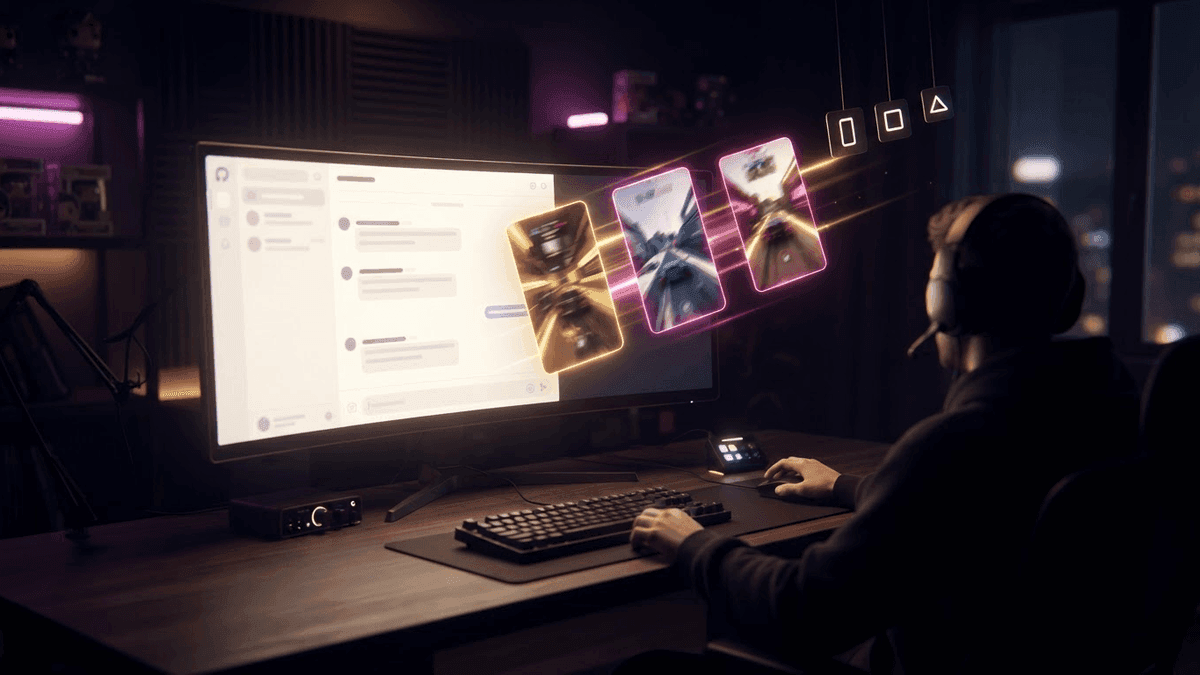
- Framing. The stream is 16:9, the clip is 9:16. The AI separates the facecam from the gameplay and recomposes: cam on top, action below, or full frame on the cam when it is a reaction. On a stream without a facecam, it follows the action.
- Captions. Animated, word by word, synced to the step 1 transcript. They read without sound, which is how most TikTok views happen.
- The hook. A line of text in the first second, written from what happens in the clip. It gives a reason not to scroll.
- Pacing. A cut one second before the trigger, an end as soon as the emotion drops, and sometimes a loop when the end meets the start.
All of that is fixed in a minute in a clip editor when the AI picked the wrong frame or the wrong word. The goal is not automatic perfection, it is to start from a 90 percent clip instead of an empty timeline.
Step 5: publish
The last link is publishing. A clip that stays in a folder is useless. Serious tools publish straight to TikTok, YouTube Shorts and Instagram Reels, with the description, the hashtags and the schedule. On our side it is called AutoPilot: approved clips are scheduled and go out while you play.
Why podcast tools miss gaming
Most AI clipping software on the market was born for podcasts: two people facing the camera, talking for an hour. On that format, the transcript is enough. The big moment is a sentence; the cut is a speech pause; the framing is the face of whoever is talking.
A stream does not work like that. A clutch often happens without a word. A laugh has no topic. A facial reaction has no transcript. The gameplay changes on screen without anyone commenting. A tool that only reads sentences outputs bits of conversation, and leaves in the VOD exactly what your chat wanted to see again.
That is why the first selection criterion, before price, is: does the tool read audio and frames, or only speech? Our AI clipper comparisons go through that point tool by tool.
What the AI still misses
Let's be honest, there are moments no scoring sees.
- Inside jokes. A reference only your community gets has no measurable signal. To the AI, it is a sentence like any other.
- Slow build-ups. Tension rising over ten minutes before exploding produces a clip that starts too late. A 45 second clip cannot tell the ten minutes.
- Moments that need context. "He did it" is only funny if you know what he was supposed to do.
- Very calm streams. No break, no signal. A knitting stream at an even voice will produce few clips, and that is normal.
That is why we prefer one-click approval to blind automation: the AI proposes, you confirm in thirty seconds, and you add by hand the clip only your community can understand.
How to pick your AI clipping software
Five questions, in order:
- Does it read audio and frames, or only the transcript? Test it on a VOD with a silent clutch.
- Are the captions good in your language, synced to the word?
- Does the reframing split facecam and gameplay on its own?
- Does it publish straight to TikTok, Shorts and Reels, or do you have to download and repost?
- Is there a real free plan to test on your own streams?
StreamClipping AI answers yes to all five, with an honest precision on the first one: audio and transcript are read on every plan, the frame pass runs on Pro and Elite. Animated captions, automatic reframing, AutoPilot, and 15 minutes of video free per month forever, no credit card. Paste the link of your last Twitch VOD and judge for yourself.
Also worth reading:
- Which clipping software to pick in 2026
- How to spot the best moments of your stream to clip them
- What is clipping? Definition and how it works
Made with love, by a streamer for stream lovers. Ragnarlebroc.